Context Windows
---
Research checked: 20 September 2026.
A context window is the bounded amount of tokenized information a model can process in a call. In many systems, instructions, conversation history, retrieved material, tool results, and generated output compete for a shared budget, although exact accounting varies. A larger advertised window increases capacity. It does not establish that the model will use every part of that capacity reliably.
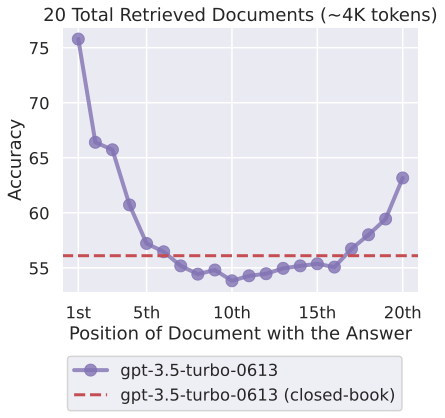
Source: Figure 1 from Liu et al., “Lost in the Middle: How Language Models Use Long Contexts” (2023).
The problem has both computational and behavioral parts. For standard dense self-attention, processing a sequence involves pairwise interactions whose arithmetic grows quadratically with sequence length. FlashAttention improves the execution of exact attention through memory-aware tiling, avoiding storage of the full attention matrix in high-bandwidth memory. It does not turn dense attention’s arithmetic into a linear-time algorithm. Dao et al., FlashAttention.
During generation, cached keys and values also consume memory as context grows. Grouped-query attention reduces the number of distinct key-value heads relative to ordinary multi-head attention, lowering cache requirements while seeking to preserve quality. This is an architectural efficiency measure; it does not guarantee that a model interprets a long document correctly. Ainslie et al., GQA.
Behavioral limitations require separate tests. Lost in the Middle found that the position of relevant material could significantly affect performance in the evaluated models. RULER extends long-context evaluation beyond a single hidden-fact lookup, including tasks involving multiple pieces of information and aggregation. Together, these studies motivate measuring effective context use, rather than treating a maximum token count as an accuracy guarantee. Liu et al., Hsieh et al., RULER.
For an application, I would distinguish several interventions. Retrieval selects relevant source material. Summarization compresses history. External state stores durable facts such as decisions, identifiers, and completed actions. Decomposition divides a large task into smaller calls. Each reduces what one call must carry, but each introduces a different possible failure: missed evidence, lost detail, stale state, or incorrect combination of partial results.
Imagine an assistant managing a long research project. Its immediate context could contain the current question, the accepted constraints, and the relevant evidence. A separate record could preserve earlier decisions and source locations. When an old detail becomes necessary, the system could retrieve the original passage instead of relying exclusively on a compressed summary. This is a proposed workflow, not a claim that persistent memory is automatically accurate.
Recursive language models explore a related strategy by treating large inputs as external objects that can be inspected and partitioned programmatically. They address access to information outside a single prompt, while leaving each underlying model call bounded. Zhang, Kraska, and Khattab, Recursive Language Models.
A realistic evaluation should place evidence at different positions, add plausible distractors, include contradictions, and ask questions requiring information from multiple sections. Check both the final answer and whether it cites the right evidence. The context problem has several partial solutions because capacity, cost, retrieval, and reasoning are different constraints. A reliable system needs to address the constraint actually causing its failures.