Jev AI
---
Research checked: 20 September 2026. This article covers Jev from TypeSafe AI.
TypeSafe AI introduced Jev on 15 September 2026 as its first public “System One” model, initially available through early access. The company positions it around fast, structured decisions inside software. A caller supplies state and bounded questions; the model returns values that application code can use directly. This is the product’s central proposition, rather than a claim that it can replace every use of a generative language model. TypeSafe’s launch announcement.
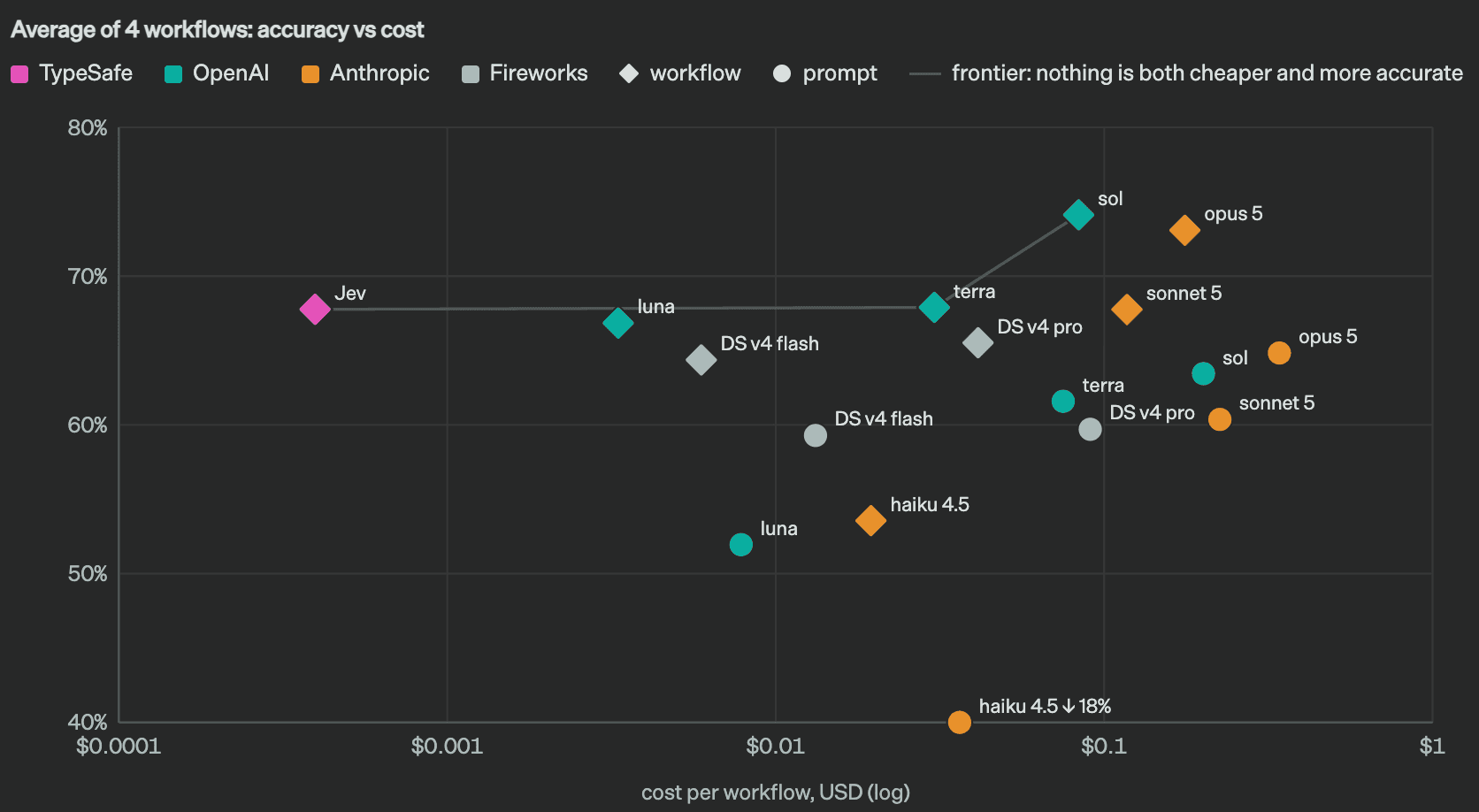
Source: benchmark chart from TypeSafe’s Jev launch post. These are company-published results, not an independent comparison.
The documentation describes three question types. Choice selects among options and returns probabilities and confidence. Score evaluates against a rubric and also returns a distribution and confidence. Noul evaluates a true-or-false proposition as a value between zero and one; it does not include the same separate confidence field. Multiple questions can share the same state, and TypeSafe recommends decomposing complex judgments into smaller questions combined by application logic. TypeSafe documentation.
For example, a support system might ask which department should receive a message and separately assess whether the message describes an urgent service interruption. Ordinary code could combine those answers with account information and routing rules. This is an illustrative use case, not a tested result. Its appeal is that application developers retain explicit control over how separate judgments affect the workflow.
TypeSafe calls its training approach Reinforcement Learning for Calibrated Decisions, or RLCD. At launch it advertised response times of 70–500 milliseconds and input pricing of $0.042 per million tokens, with no output-token charge. Those are vendor-reported launch figures, not measurements made for this article. The launch post also explains that its workflow evaluations use reference probabilities from other models and acknowledges potential benchmark and location effects. TypeSafe’s launch announcement.
The phrase “no hallucinations” needs a narrower reading than “always correct.” TypeSafe connects its guarantee to schema matching and the inability to produce values outside the allowed structure. As a matter of logic, selecting a valid option can still be the wrong decision. A support request routed to “billing” is type-correct even if the evidence calls for “technical support.” The distinction separates interface validity from semantic accuracy.
Confidence also requires care. TypeSafe documents its Choice and Score confidence value as a statistic derived from the returned probability distribution. It should not automatically be interpreted as the empirical probability that an action will be correct in a particular deployment. That interpretation needs validation on representative examples. TypeSafe, Confidence.
I would evaluate Jev against a conventional classifier and a language model using structured output, with the same inputs and labeled cases. Measure accuracy, calibration, abstention behavior, total cost, and latency from the intended region. Include ambiguous examples and distribution shifts. The interesting possibility is a model interface designed specifically for bounded judgments. Whether it improves a real workflow remains an empirical question beyond the launch claims.