Recursive Language Models
---
Research checked: 20 September 2026.
A recursive language model, or RLM, changes how an AI system handles a large input. Instead of placing the entire document collection inside one prompt, it keeps that collection in an external environment. The model can inspect it programmatically, select relevant portions, and invoke language-model calls on those portions. The term here refers specifically to the inference strategy introduced by Zhang, Kraska, and Khattab. Recursive Language Models.
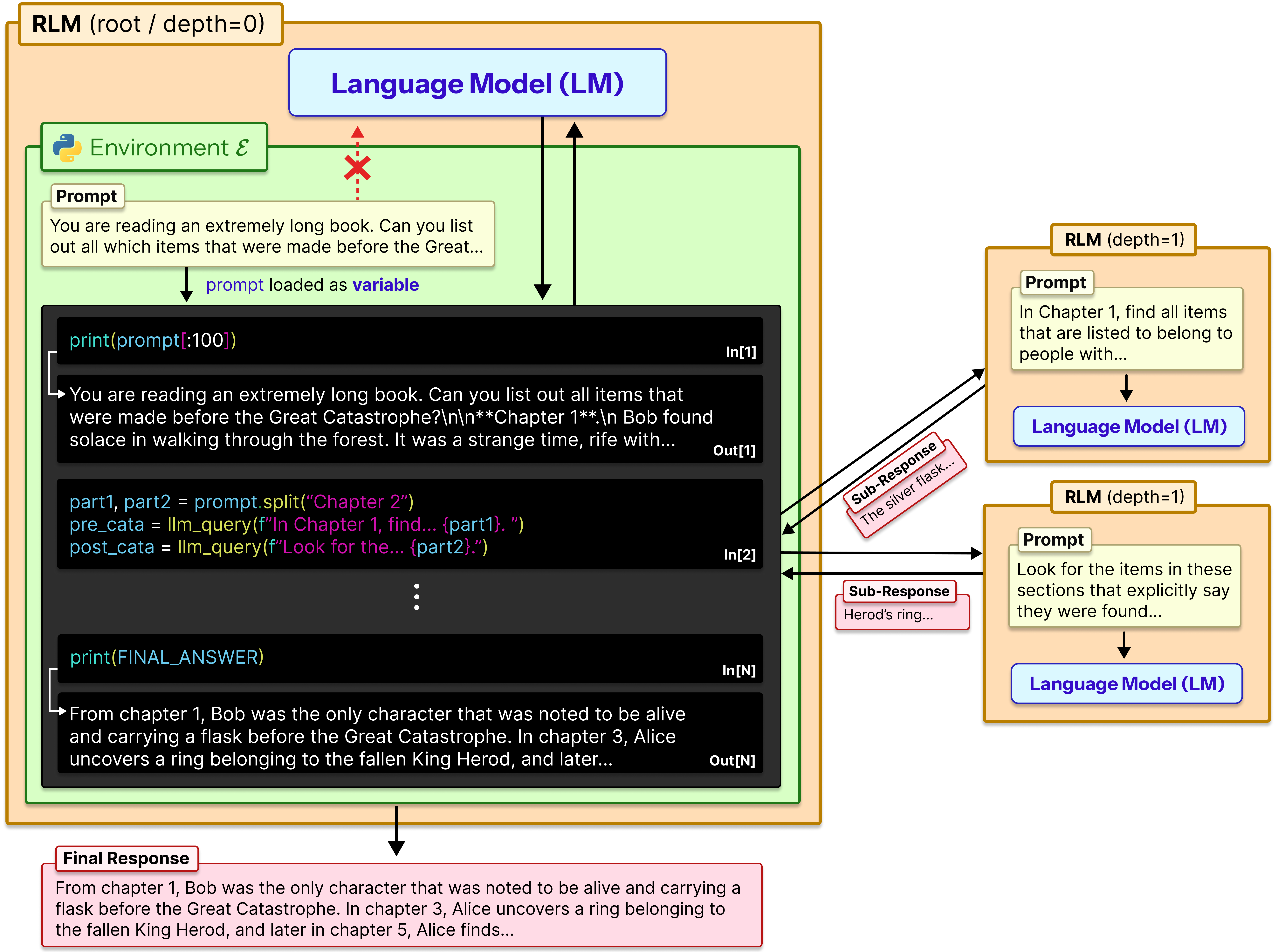
Source: Figure 2 from Zhang, Kraska, and Khattab, “Recursive Language Models”.
The architectural distinction is where the bulk input lives. In the authors’ implementation, a Python REPL holds the context as a variable. The root model writes code to inspect or partition that variable and can call a model on selected text. Only the information exposed through this interaction enters the root model’s immediate context. The external environment therefore becomes a working surface for choosing what to read. Zhang, Recursive Language Models.
Imagine reviewing a year of support tickets to identify a recurring failure. A possible RLM workflow would first count tickets by product version, examine examples from suspicious groups, ask subcalls to classify ambiguous complaints, and combine the findings. This is an illustrative application: the important move is allowing the system to choose and revise its reading strategy instead of fixing every chunk in advance.
The published paper reports strong results on several long-context tasks, including inputs much longer than the underlying models’ context windows. These are benchmark findings for particular models, tasks, and configurations. They do not establish literally unlimited usable context or guarantee lower costs for every workload. Individual calls remain bounded, and the surrounding computation still consumes time and resources. Zhang, Kraska, and Khattab.
The technique relates to RAG but makes a different design choice. A retrieval pipeline generally selects evidence through an index and retrieval procedure. An RLM gives the model more responsibility for navigating and transforming the available input. The two can be combined: a recursive workflow could use a search index as one of its tools. The authors’ early explanation also notes that their initial experiments limited recursion depth; a recursive interface does not imply an arbitrarily deep call tree in every evaluation. Zhang’s project explanation.
My engineering concern would be coverage. A model might search for the obvious symptom and miss differently worded evidence. A subcall might return an incorrect summary that the root accepts. A final aggregate might accidentally count the same ticket twice. Logging selected ranges, retaining source identifiers, and checking deterministic calculations would make these failures easier to find. Call budgets and stopping rules would also help prevent unproductive expansion.
An informative evaluation would compare the system against direct long-context prompting and a strong retrieval baseline under comparable cost limits. Include tasks requiring exhaustive counting as well as selective lookup. RLMs are especially interesting because they move the research question from how much text fits into a prompt to how effectively a model can organize its access to information.