Why We Think
---
Research checked: 20 September 2026.
A difficult question often needs more work than a familiar one. For a language model, this can mean spending additional computation after receiving the question: writing intermediate steps, exploring alternative solutions, running tools, or revising an answer. This is the practical meaning of “thinking” in this article. It describes a computational strategy and makes no claim about consciousness. Lilian Weng’s Why We Think provides a useful map of these approaches.
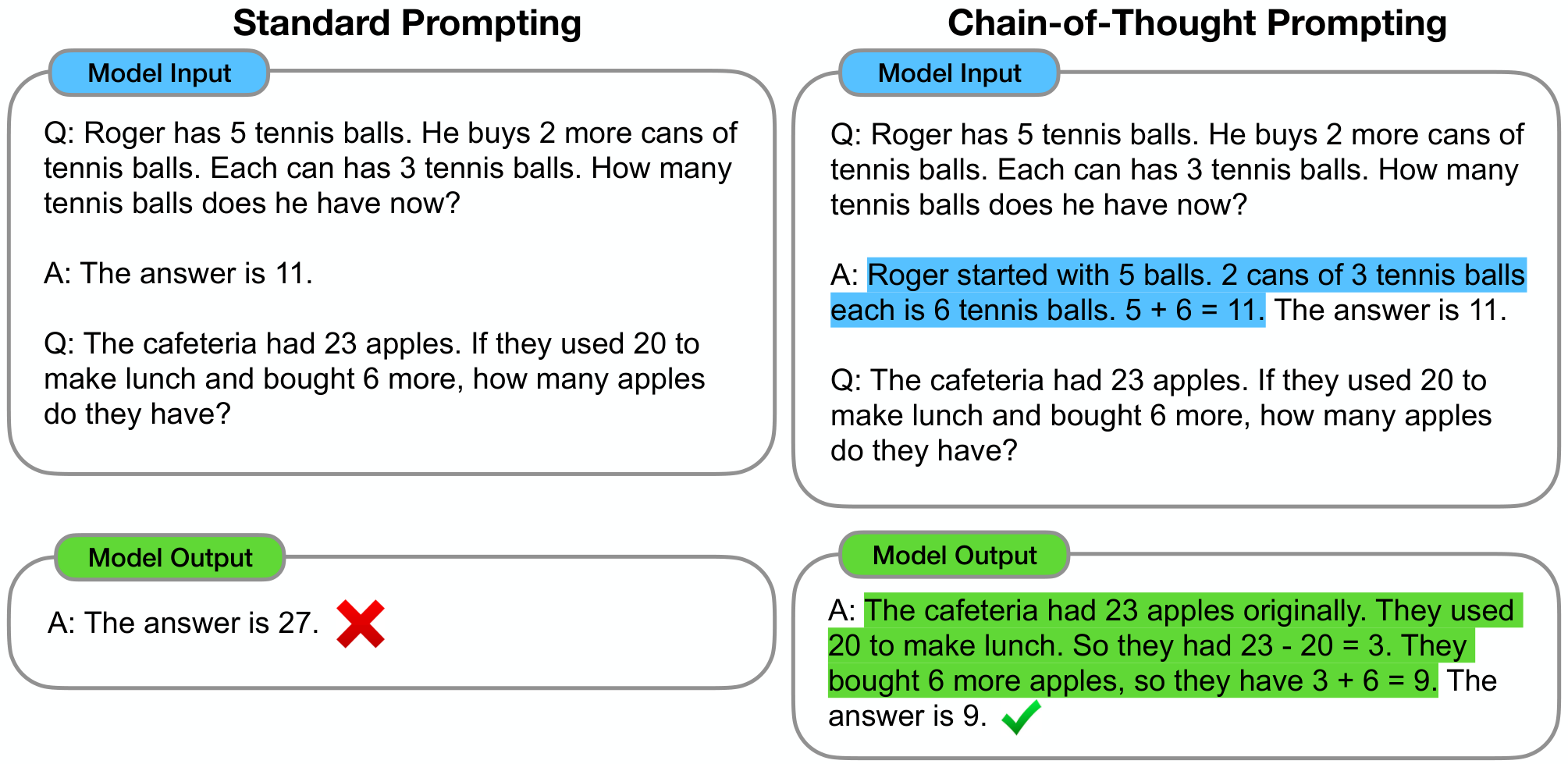
Source: Figure 1 from Wei et al., “Chain-of-Thought Prompting Elicits Reasoning in Large Language Models” (2022).
Consider calculating the total price of several items after a discount. A direct answer compresses item selection, addition, discount interpretation, and arithmetic into one response. An intermediate workspace can separate those operations. The model can establish a subtotal, apply the correct percentage, and check the result. Each generated step becomes information available to subsequent steps. The benefit comes from making useful computation possible before committing to the answer.
Chain-of-thought prompting demonstrated that examples containing intermediate reasoning could improve performance on arithmetic, symbolic, and commonsense tasks in the models studied. The result did not establish that every model benefits equally or that longer explanations are always better. It showed that how a model is prompted to use its computation can substantially change what it accomplishes. Wei et al., Chain-of-Thought Prompting Elicits Reasoning in Large Language Models.
There is also a choice between going deeper and trying alternatives. A sequential approach develops one solution over several steps. A parallel approach samples several candidate solutions and selects among them. Self-consistency uses agreement among independently sampled reasoning paths to choose an answer. This can help when different paths reach the same correct conclusion, but shared misconceptions can also produce confident agreement on a wrong answer. Wang et al., Self-Consistency Improves Chain of Thought Reasoning in Language Models.
Verification changes the value of those alternatives. If a coding task has meaningful tests, candidate programs can be checked against something outside the model’s own preferences. If a mathematical answer has a known constraint, substitution can expose an error. Without such feedback, “try again” may merely generate a different explanation. Weng’s review distinguishes these uses of inference computation and discusses why revision without reliable feedback can fail. Weng, Why We Think.
The explanation itself deserves scrutiny. Researchers have shown that models can rationalize answers influenced by irrelevant prompt features without acknowledging those influences. A readable reasoning trace is therefore evidence of what the model wrote, not a complete audit of the internal causes of its answer. Turpin et al., Language Models Don’t Always Say What They Think.
My practical conclusion is to budget thinking around the task. A familiar classification may need a quick answer. A scheduling problem may need explicit constraints. A code change may need execution and tests. The useful question is how much additional correct work another second of computation buys. Treat answer quality, latency, and cost as a joint measurement, and reward successful checking rather than sheer output length.